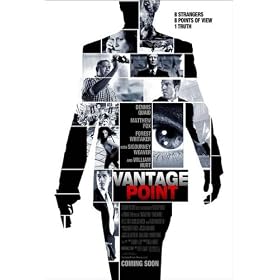
 Vantage Point
Written by Barry Levy
Directed by Pete Travis
Score: 4 out of 10 vantage points.Vantage Point is not the sort of movie one walks into expecting to find art or intelligent commentary on the greater problems of the world. It is, after all, an action flick, and it is clearly billed as such. And so it is only fair that one does not judge a film like Vantage Point against more hearty fare, movies with messages and agendas. The only question one needs to ask oneself while shuffling, blinky-eyed, into the bright theater lobby is: Was it worth the price of popcorn? The answer: Only barely. 'Cuz I was hungry.
The premise (or “gimmick,” if you like) is this: A terrorist plot to assassinate the President of the
The concept is clear enough, and even potentially interesting, but it becomes a problem in the final act when the filmmakers apparently tire of the format and abandon, without cue or warning, the perspective-based structure that has been the core of the film in favor of a traditional linear narrative. From the perspective of no one in particular, the final twists and revelations are revealed in a typical and anticlimactic fashion: We’re handed a predictable betrayal, a car chase that tops nothing done in any of the Bourne films, and a completely underdeveloped and vague motive that leaves the audience asking “Why?” Or, in my case, “Why, oh WHY?!”
The filmmakers’ laziness, unfortunately, is not confined to the last third of the film. From start to finish, the dialogue is empty, non-specific, and almost always bordering on silly. And despite attempts to round out the characters (Dennis Quaid's Secret Service agent's backstory of taking a bullet for the president, for example), everyone in the film seems to be missing at least two dimensions. The best example of this is Forrest Whittaker’s character, a tourist with a heart three sizes too big and a magic video camera that picks up on details so small that even trained Secret Service agents are no match for its astuteness. If this weren’t absurd enough, he later becomes a superhero in ordinary clothes, involving himself in the action to a point that is both unbelievable and frustrating.
Passing for a cohesive story is a string of minutely interesting details that attempt to connect each of the different perspectives. It is because of this that Vantage Point feels a giant Easter Egg made especially for the daft. All of the small, rewind-worthy connections that make television shows like LOST rich and exciting are here made blatant and simple, underlined 3 times and highlighted in bright pink so that even those half asleep won’t miss a single thing. This heavy-handedness insults the audience’s intelligence (forgive that moment of optimism) and completely drains the movie of any potential re-watch value it may have had were it more subtle.
But, then again, maybe it’s just me. After the film, in the restroom, two young men described the film as “weird” and “interesting,” two words I’d never have thought to use in describing a film so obvious and calculated. I guess it was just a better movie from wherever they were sitting.

No comments:
Post a Comment